
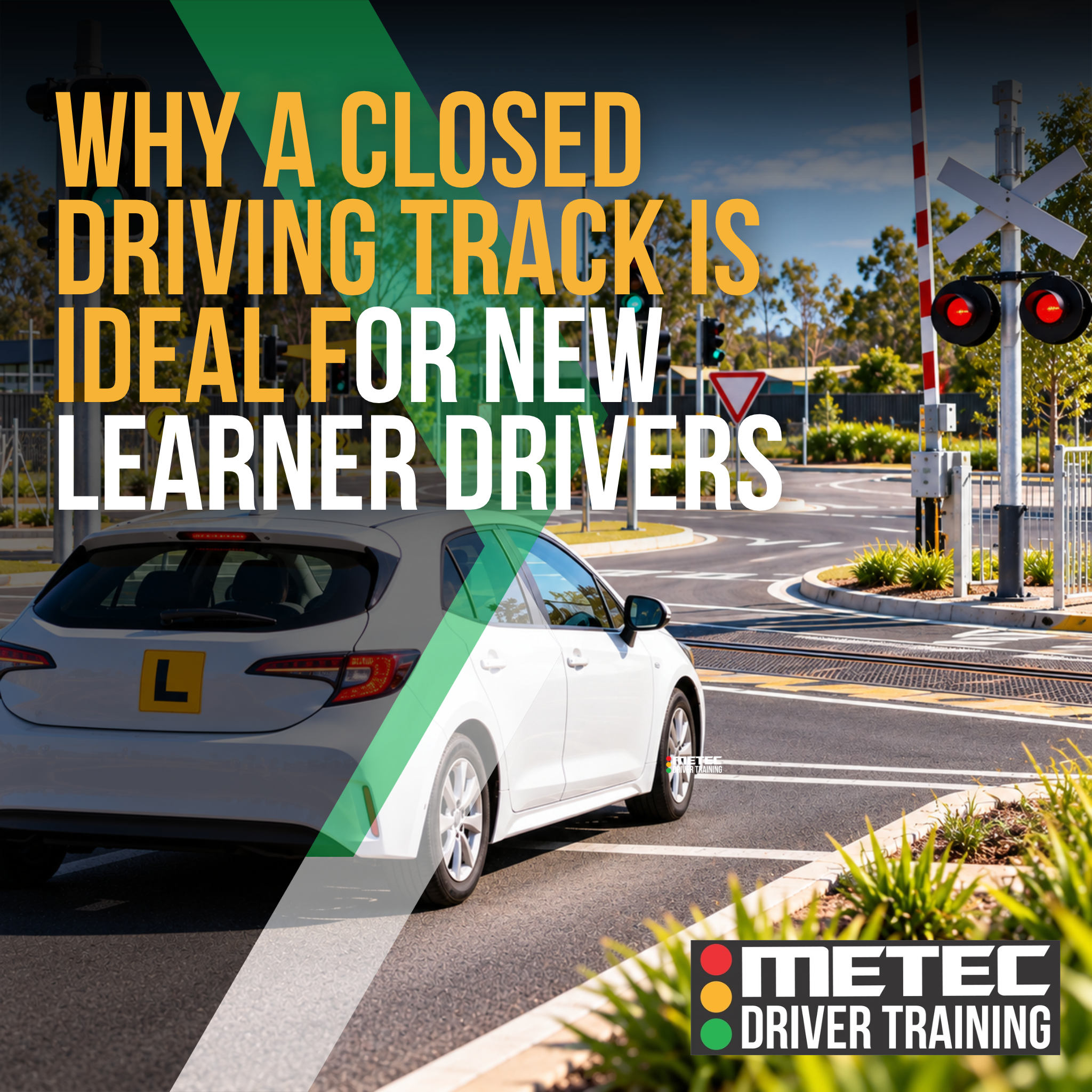
Learning to drive for the first time can be exciting, but it can also feel overwhelming. New learner drivers need to think about steering, braking, mirrors, indicators, road positioning and traffic rules — often all at once.
For someone with little or no driving experience, heading straight onto busy Melbourne roads can add unnecessary pressure.
That's where learning on a closed driving track can make a real difference.
At METEC Driver Training in Melbourne, new learner drivers can develop essential driving skills in a controlled environment before progressing to increasingly complex real-world road conditions.
What Is a Closed Driving Track?
A closed driving track is a dedicated training environment where learners can practise driving away from everyday public traffic.
Unlike practising in a quiet car park, a purpose-built driver training facility can expose learners to realistic road features and situations while allowing training to be delivered in a more controlled setting.
METEC's driver training facility includes road infrastructure such as intersections, real traffic lights, a railway crossing and a closed circuit, providing learners with opportunities to practise important driving skills before encountering similar situations on public roads.
1. Less Pressure for First-Time Drivers
For a brand-new learner, even basic vehicle controls can require a lot of concentration.
Adding surrounding traffic, pedestrians, cyclists and impatient motorists can make the experience more stressful.
A closed track reduces many of these external pressures, giving learners more opportunity to concentrate on the fundamentals of driving.
This can be particularly valuable for nervous learner drivers or those getting behind the wheel for the first time.
2. Learn Basic Vehicle Control
Before learners start dealing with complex traffic situations, they need to understand how the vehicle responds.
A controlled driving environment provides an opportunity to practise fundamental skills such as:
- Starting and stopping
- Steering and road positioning
- Smooth acceleration and braking
- Using mirrors
- Indicating
- Performing head checks
- Approaching intersections
- Following road markings and signs
Repeating these skills helps learners become more familiar with the vehicle and allows them to focus on developing good driving habits from the beginning.
3. Build Confidence Before Driving on Public Roads
Confidence doesn't usually appear after one driving lesson. It develops gradually through practice and experience.
For some learners, starting on public roads can make them feel rushed or nervous. A closed driving track allows them to build familiarity with driving before introducing the additional challenges of everyday traffic.
Once basic skills become more comfortable, learners can progress to more complex situations with a stronger foundation.
The aim isn't to make learners overconfident — it's to help them become calm, capable and aware behind the wheel.
4. Experience Realistic Road Features
One of the biggest advantages of a purpose-built driver training facility is that learners aren't simply driving around an empty open space.
At METEC, learners can encounter realistic road infrastructure in a controlled training environment.
This includes features such as:
- Traffic lights
- Intersections
- Road signs and markings
- Railway crossing
- Closed driving circuits
These features allow instructors to introduce real-world driving concepts while learners are still developing their fundamental skills.
5. Practise Skills More Than Once
On a public road, learners don't always get another opportunity to immediately repeat a difficult situation.
On a closed track, instructors can provide more structured opportunities to practise particular skills and scenarios.
If a learner needs more practice approaching an intersection, controlling their speed or positioning the vehicle correctly, the exercise can be repeated.
This repetition can help learners understand what they need to improve rather than simply moving on to the next situation.
6. Develop Good Driving Habits Early
The habits developed during the first few hours behind the wheel can influence how a learner approaches driving later.
Learning in a structured environment gives instructors an opportunity to reinforce important habits from the beginning, including:
- Regular mirror checks
- Correct observation techniques
- Appropriate speed control
- Safe road positioning
- Clear indication
- Looking ahead for potential hazards
- Making considered driving decisions
Developing these habits early can provide a stronger foundation as learners progress to public-road driving.
7. Ideal for Nervous Learner Drivers
Not every learner approaches their first driving experience with the same level of confidence.
Some are eager to get started, while others may be nervous about controlling the vehicle or making a mistake.
A closed driving track can provide a more approachable starting point for nervous learners.
Instead of worrying about holding up other motorists or reacting to unpredictable traffic, learners can concentrate on understanding the vehicle and following their instructor's guidance.
As their skills develop, more challenging situations can gradually be introduced.
8. Professional Instruction Makes a Difference
A closed driving track is most effective when combined with structured professional instruction.
An experienced driver trainer can identify areas that need improvement, explain techniques clearly and adjust exercises to suit the learner's current ability.
Rather than simply accumulating driving hours, learners can focus on developing specific skills and understanding why safe driving techniques matter.
This combination of professional instruction and a controlled environment can be especially beneficial during the early stages of learning to drive.
When Should Learners Progress to Public Roads?
There isn't one specific number of hours that determines when every learner is ready for more complex driving environments.
Learners develop at different rates.
Before progressing, they should have a reasonable understanding of basic vehicle controls, observations, steering, braking, speed management and road positioning.
The transition should be gradual, moving from controlled environments to quieter roads before introducing increasingly busy and complex traffic situations.
Learn to Drive at METEC's Dedicated Melbourne Training Facility
For new learner drivers, the first few hours behind the wheel are an important opportunity to establish strong driving foundations.
METEC Driver Training in Melbourne provides learner driver programs using a dedicated training facility where learners can develop practical skills in a structured environment.
With realistic road infrastructure, a closed circuit and professional driver instruction, METEC helps learners build their vehicle control, road awareness and confidence before progressing to more challenging driving environments.
Whether you're a first-time learner or a parent looking for a supportive place for your child to begin learning, METEC provides a practical environment for developing safer driving skills.
Explore METEC's learner driver training programs and start building confidence behind the wheel.